


Engaging Employees for Real Results
EMPLOYEE ENGAGEMENT
Companies lose $350 billion a year because of employee disengagement. Your company does NOT have to be one of them.
Disengaged employees and a high turnover rate impact your business' productivity, level of innovation, and ultimately the bottom line. Our white paper, Beyond Rules of Engagement, discusses effective strategies and tactics that build a corporate culture of engagement:
• Understand the benefits of having an engaged staff
• Avoid mistakes many companies make
• Learn specific tips for Individuals, Coworkers, Managers, the HR Department, and Senior Management
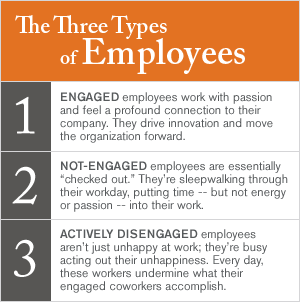
Building a constituency of engaged employees
If employees truly are a company's best asset, then their care and support should be a priority.
Though important at the organizational level, engagement starts with each person and is subjective. Employees don't check their personalities at the door when they come to work. Knowing that they are respected as individuals at work can have a significant impact on how employees view their overall lives.
Each person's potential extends well beyond his or her job description. And tapping that potential means recognizing how an employee's unique set of beliefs, talents, goals, and life experiences drives his or her performance, personal success, and well-being.
Managers and leaders should know their people -- who they are, not just what they do. Every interaction with an employee has the potential to influence his or her engagement and inspire discretionary effort. How leaders manage their employees can substantially affect engagement levels in the workplace, in turn influencing the company's bottom line.
Five Strategies organizations can use to help build their constituency of engaged employees:
1. Use the right employee engagement survey. When a company asks its employees for their opinions, those employees expect action to follow. But businesses often make the mistake of using employee surveys to collect data that are irrelevant or impossible to act on. Any survey data must be specific, relevant, and actionable for any team at any organizational level. Data should also be proven to influence key performance metrics.
2. Focus on engagement at the local and organizational levels. Real change occurs at the local workgroup level, but it happens only when company leaders set the tone from the top. Companies realize the most benefit from engagement initiatives when leaders weave employee engagement into performance expectations for managers and enable them to execute on those expectations. Managers and employees must feel empowered to make a significant difference in their immediate environment. Leaders and managers should work with employees to identify barriers to engagement and opportunities to effect positive change. Employees are familiar with the company's processes, systems, products, and customers. They are also experts on themselves and their teams. So it makes sense that they will have the best ideas to maximize these elements and deliver improved performance, business innovation, and better workplace experiences.
3. Select the right managers. The best managers understand that their success and that of the organization relies on employees' achievements. But not everyone can be a great manager. Great managers care about their people's success. They seek to understand each person's strengths and provide employees with every opportunity to use their strengths in their role. Great managers empower their employees, recognize and value their contributions, and actively seek their ideas and opinions. It takes talent to be a great manager, and selecting people who have this talent is important. Whether hiring from outside or promoting from within, businesses that scientifically select managers for the unique talents it takes to effectively manage people greatly increase the odds of engaging their employees. Companies should treat the manager role as unique, with distinct functional demands that require a specific talent set.
4. Coach managers and hold them accountable for their employees' engagement. Gallup's research has found that managers are primarily responsible for their employees' engagement levels. Companies should coach managers to take an active role in building engagement plans with their employees, hold managers accountable, track their progress, and ensure that they continuously focus on emotionally engaging their employees.
5. Define engagement goals in realistic, everyday terms. To bring engagement to life, leaders must make engagement goals meaningful to employees' day-to-day experiences. Describing what success looks like using powerful descriptions and emotive language helps give meaning to goals and builds commitment within a team. Make sure that managers discuss employee engagement at weekly meetings, in action-planning sessions, and in one-on-one meetings with employees to weave engagement into daily interactions and activities and to make it part of the workplace's DNA.
Leaders in the best companies strategically align their employee engagement efforts. They find ways to communicate engagement's effect throughout the year and share best practices across the organization. They use every opportunity, touchpoint, and communication channel to reinforce and recognize the organization's commitment to employee engagement. They integrate employee engagement fully into the business' lexicon.
About Morale
According to sociologist Alexander Leighton, "morale is the capacity of a group of people to pull together persistently and consistently in pursuit of a common purpose."
For your organization to thrive, it's essential to take the time to develop good morale.
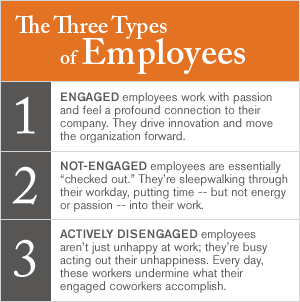
Almost by definition, organizations with high morale experience higher productivity and staff engagement, they show lower employee turnover and absenteeism, and they have a happier workforce. What's more, they find it easier to attract and retain the best talent. While "raising morale" can seem to be a nebulous goal, many of these other effects are measurable, and directly affect the bottom line.
Last but not least, it feels great to work in an organization where morale is high!

Comments